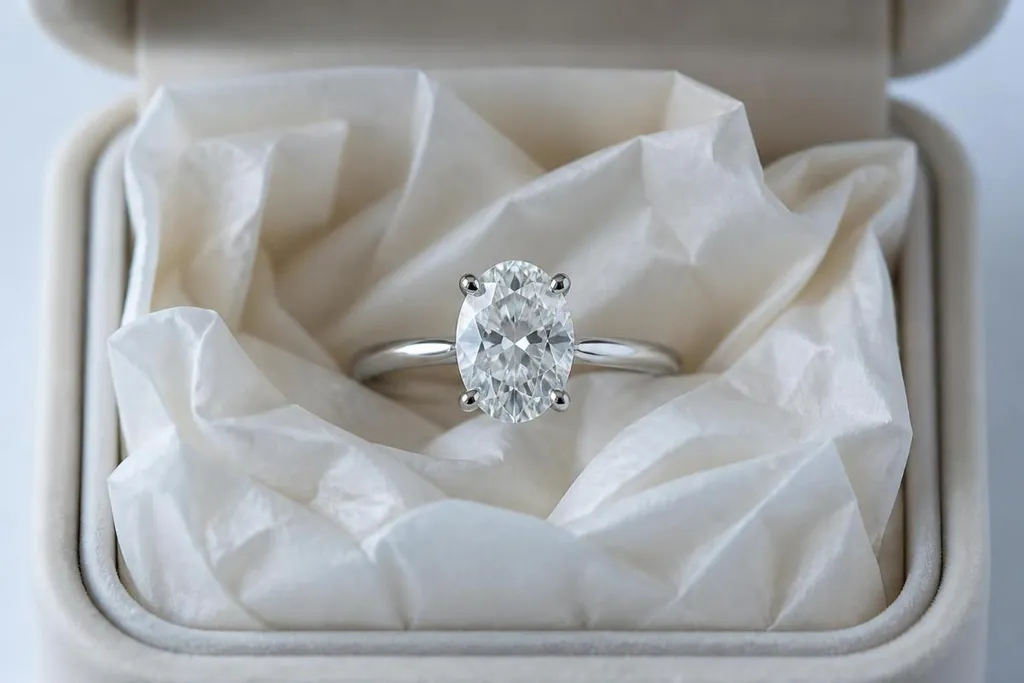
An oval diamond manages a difficult balance: it feels immediately recognisable yet noticeably different from the traditional round brilliant. Its elongated outline creates an elegant presence across the finger, while brilliant-style faceting delivers the lively sparkle many people expect from an engagement diamond. That combination has made the shape especially appealing to those who want something contemporary without choosing an overtly unconventional design.
Exploring beautiful lab diamond oval cut rings shows how much the character of an oval lab-grown diamond can change according to its proportions and setting. Some ovals are slender and elongated; others have a fuller silhouette. Neither is automatically preferable. The right choice depends on the wearer's hand, preferred setting and the visual effect they want the finished ring to achieve.
Why Oval Diamonds Can Look So Flattering
The length of an oval diamond naturally draws the eye along the finger rather than across it. This can create a graceful, lengthening effect, particularly when the stone is set vertically in a solitaire or a fine diamond-set band.
Oval diamonds can also offer generous face-up presence. Because their weight is distributed across an elongated surface, they may appear visually substantial for their carat weight. However, dimensions matter more than assumptions based on the number on a certificate. Two 2-carat oval diamonds can have noticeably different lengths and widths.
This is where personal preference becomes important. Someone may choose a 2-carat oval not simply because it is larger than a 1-carat stone, but because its length creates the finger coverage they prefer. Another wearer may find that a smaller oval gives a more delicate balance with a fine band or petite hand.
The goal is proportion, not maximum scale.
Understanding Length-to-Width Ratio
One of the defining characteristics of an oval diamond is its length-to-width ratio. This figure describes how elongated or rounded the stone appears.
A lower ratio generally produces a broader, fuller oval, while a higher ratio creates a narrower and more elongated silhouette. There is no universally correct ratio. A fuller oval can have a strong, substantial appearance, whereas a slender stone may feel particularly graceful and contemporary. Symmetry deserves close attention too. Because the outline is elongated, uneven curves or mismatched ends can be easier to notice than they might be in a round diamond.
Another characteristic associated with oval brilliant cuts is the “bow-tie” effect—a darker area that can appear across the centre of the stone under certain lighting. Some degree of bow-tie can occur naturally, but its visibility varies. Examining the diamond itself, rather than relying exclusively on grading information, helps determine whether the effect complements or distracts from its overall appearance.
Choosing a Setting That Suits an Oval Diamond
Oval lab diamonds adapt easily to different engagement ring styles. A solitaire emphasises their outline and gives the elongated shape plenty of visual space. A slim band can further accentuate the centre stone without introducing competing detail.
Diamond-set shoulders add brilliance along the finger and can create a smooth transition from the oval centre into the band. Halo settings increase the overall footprint and reinforce the stone's curved outline, while hidden halos provide additional side-profile sparkle without changing the clean face-up shape as dramatically.
The claws themselves affect appearance. Four-claw settings can keep more of the outline exposed, while additional claws may provide a different visual balance and sense of security.
Setting height is worth considering for practical reasons. Someone with an active lifestyle may prefer a more streamlined profile, while a higher setting can give the oval diamond greater prominence and may influence how a wedding band sits alongside it.
Metal and Band Proportions Matter
Metal choice can subtly shift the personality of an oval ring. Platinum and white gold offer a cool, crisp backdrop, allowing the diamond to blend visually with the setting. Yellow gold creates warmer contrast, while rose gold can soften the overall composition.
Band width is equally influential. A very fine band makes the oval appear more prominent by comparison, but the proportions should still feel structurally and visually balanced. A slightly wider band can work particularly well with larger centre stones. It is also sensible to consider the future wedding ring. Depending on the engagement ring's gallery and setting profile, a straight band may sit flush or a shaped design may provide a closer fit.
Final Thought
Oval lab diamond rings combine the brilliance associated with classic diamond jewellery with a distinctly elongated, contemporary silhouette. Their appeal lies not simply in appearing larger, but in the way length, width and setting proportions interact on the hand.
Choosing an oval thoughtfully means looking beyond carat weight. Consider its outline, symmetry, bow-tie visibility and relationship with the band. When those elements feel balanced, an oval lab diamond delivers something more enduring than a fashionable shape: elegance with genuine individuality.